

- Bulteau S, Sauvaget A, Vanier A, Vanelle J-M, Poulet E, Brunelin J, et al.
Depression Reappraisal and Treatment Effect: Will Response Shift Help Improve the Estimation of Treatment Efficacy in Trials for Mood Disorders?
Front Psychiatry. 2019;10:420.
Lire le publication
- Tessier P, Blanchin M, Sébille V.
Does the relationship between health-related quality of life and subjective well-being change over time? An exploratory study among breast cancer patients.
Soc Sci Med 1982. 2017;174:96–103.
Lire le publication
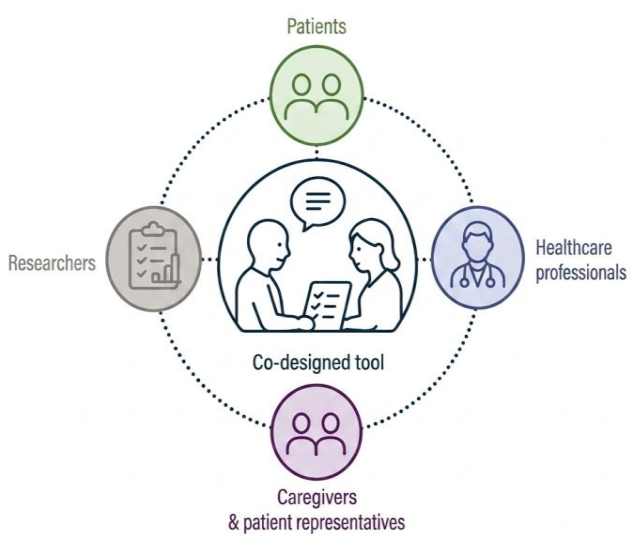
Nous nous intéressons en particulier à l’invariance de la mesure et ses implications méthodologiques et cliniques.
Dans ce but, nous avons développé et validé, par des études de simulations, des méthodes basées sur des modèles à variables latentes (modèles de Rasch, modèles à équations structurelles) pour la détection du DIF et du RS comme le RespOnse Shift ALgorithm at Item-level ROSALI. Tous les modules de logiciels statistiques automatisant les méthodes développées dans l’unité sont librement disponibles en ligne.
- Guilleux A, Blanchin M, Vanier A, Guillemin F, Falissard B, Schwartz CE, et al. RespOnse Shift ALgorithm in Item response theory (ROSALI) for response shift detection with missing data in longitudinal patient-reported outcome studies. Qual Life Res Int J Qual Life Asp Treat Care Rehabil. 2015 Mar;24(3):553–64.
Lire le publication
- Blanchin M, Guilleux A, Hardouin J-B, Sébille V. Comparison of structural equation modelling, item response theory and Rasch measurement theory-based methods for response shift detection at item level: A simulation study. Stat Methods Med Res. 2019 Oct 30;962280219884574.
Lire le publication
- Blanchin M, Brisson P. ROSALI. Stata module to detect of response shift at item-level between two times of measurement [Internet]. Statistical Software Components. 2020 [cité 17 juill 2020].
Lire le publication
- Hammas K, Sébille V, Brisson P, Hardouin J-B, Blanchin M. How to Investigate the Effects of Groups on Changes in Longitudinal Patient-Reported Outcomes and Response Shift Using Rasch Models. Front Psychol. 2020;11:3704.
Lire le publication
PERIMETER – a DEVICE project
PERception based Individualized MEasurement and Tool development for Evidence based Research
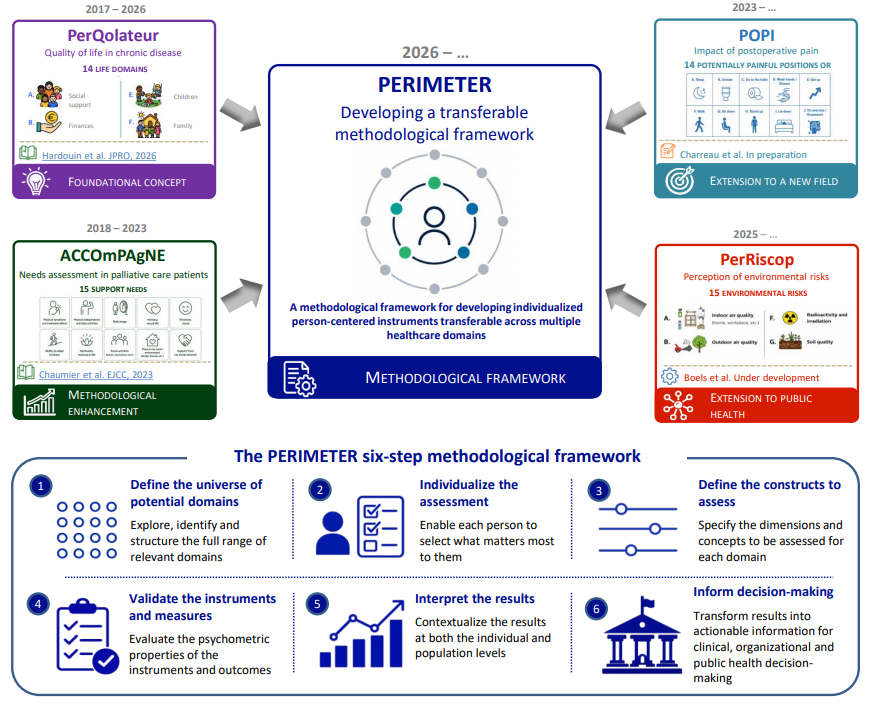
- Bringing together several projects within the DEVICE research axis under a shared methodological framework for the development of individualized person-centered instruments
- A common approach to defining, developing, validating and implementing relevant, comparable and practice-oriented instruments that can be transferred across a wide range of healthcare settings.