

Cluster randomized trials (CRTs) provide a rigorous methodological framework for the pragmatic evaluation of complex interventions in clinical research and population-health intervention research
The complexity of interventions may arise from the multiplicity of stakeholders involved, the interdependence of components, and/or the need to modify individual or organizational behaviours.
This complexity implies methodological challenges related to planning, bias prevention, definition of analysis populations, and causal interpretation of effects.
The PRACMATIC axis aims to address metholodogical challenges induced by RCTs, from trial planning through the definition of analysis population to causal interpretation.

The PRACMATIC axis aims to develop methodological research around two main objectives:
-
To optimize the design, analysis, and reporting of real-world studies with specific expertise in CRTs and advanced causal inference methods for observational studies;
-
To design and evaluate complex interventions under real-world conditions using mixed methods approaches that promote the involvement of public, patients, healthcare professionals, and stakeholders at every stage, as well as the implementation of interventions.
- Caille A., Billot L., & Kasza J. Practical and methodological challenges when conducting a cluster randomized trial : Examples and recommendations. Journal of Epidemiology and Population Health (2024)
Read the publication - Giraudeau, B., Weijer, C., Eldridge, S. M., Hemming, K., & Taljaard, M. Why and when should we cluster randomize? Journal of Epidemiology and Population Health (2024)
Read the publication - Poupin, P., Ansoborlo, M., Caille, A., Dibao-Dina, C., Fougère, B., & Giraudeau, B.Management of death-related noncompleters in cluster randomized trials carried out in nursing homes : A methodological review. Journal of Clinical Epidemiology (2022)
Read the publication
J-MINI – a PRACMATIC project
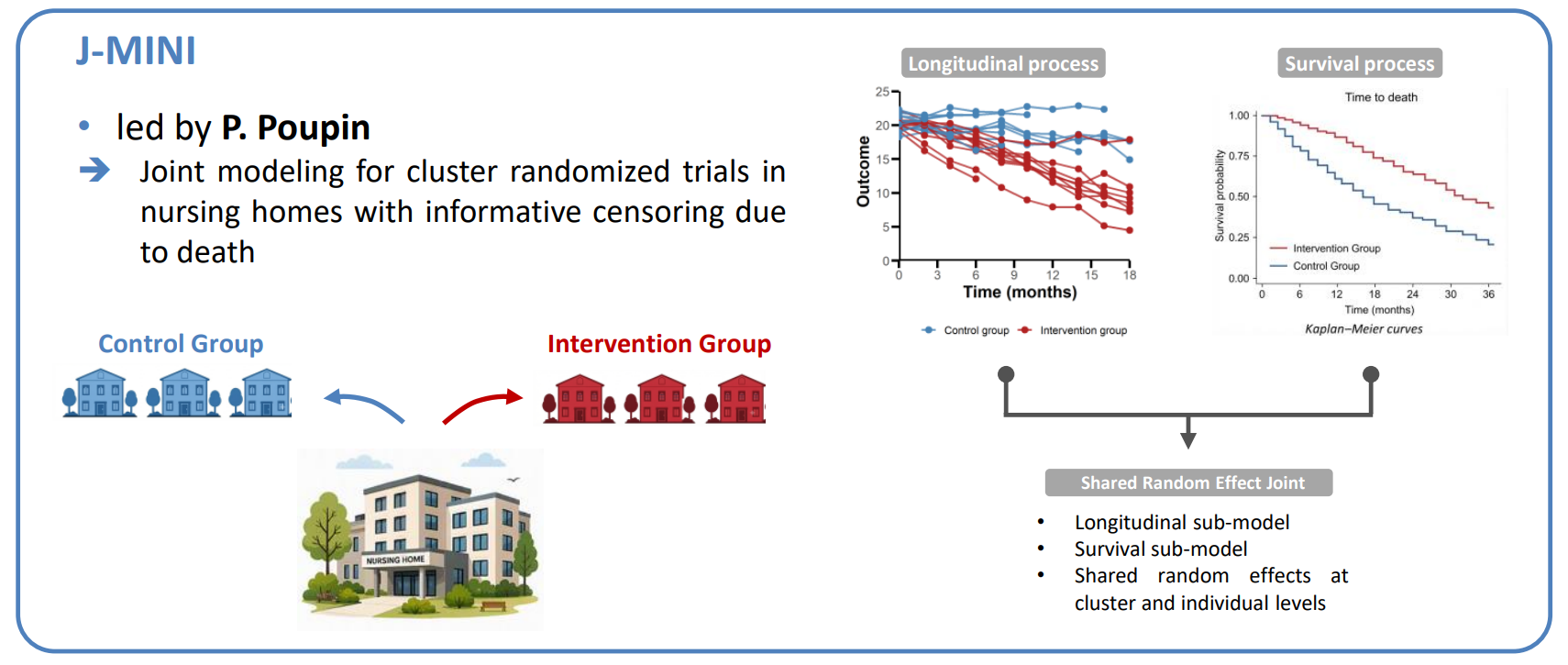
The J-MINI project focuses on the development of a statistical method to handle attrition bias in CRTs conducted among elderly populations living in nursing home. Statistical handling of attrition, particularly due to death in this population, is challenging and requires modeling informative censoring. The objective is to develop a shared random-effects joint model adapted to the statistical specificities of CRT data with a continuous primary outcome and to evaluate its performance through simulation studies.